Waist
Stand tall, relax, and measure the same landmark each time after a normal exhale.
body composition
Original guidance on taking waist, hip, neck, and skinfold measurements with fewer common mistakes.
This tool provides estimates for general informational purposes only. It is not medical or professional advice.
Measurement quality is often the biggest source of error. This page focuses on how to take usable measurements rather than overselling the formula afterwards.
Stand tall, relax, and measure the same landmark each time after a normal exhale.
Take the tape around the fullest consistent point rather than angling upward or downward.
Keep the tape level and avoid pulling it tighter on one side than the other.
Mark sites first, use the correct protocol, and repeat readings instead of trusting a single pinch.
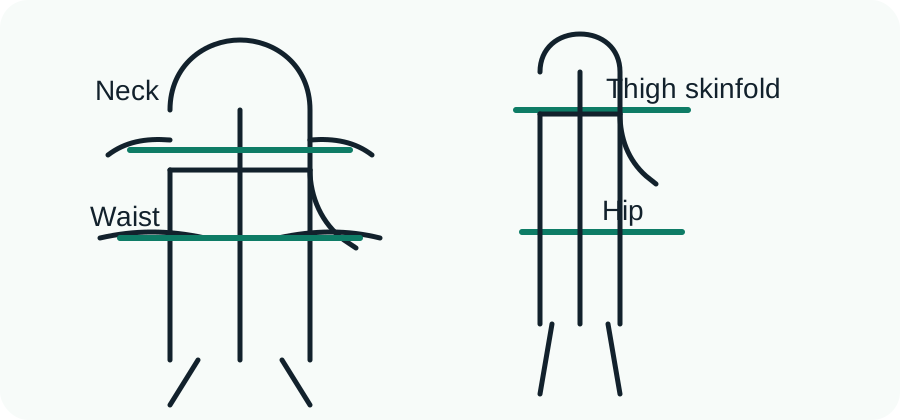
A stable, repeatable method is usually more useful for trend tracking than chasing multiple different estimates.
The guide explains common landmarks, positioning, breathing, and repetition tips in original wording, paired with simple original illustrations rather than copied diagrams.
Provides context on error, prediction quality, and the practical limits of field body-composition methods.
Last reviewed: 2026-03-31Modern validation context used for limitation notes across circumference and skinfold methods.
Last reviewed: 2026-03-31No. Body-composition tools are supporting estimates only and should not replace clinical assessment, lab testing, or professional advice.
Each tool links to its underlying method and source pages, along with a short note on assumptions, limitations, and the last review date.
body composition
Estimate body density and body-fat percentage from the published 3-site skinfold equations, then show fat mass, fat-free mass, and FFMI outputs.
body composition
Use the 7-site Jackson-Pollock method for a more detailed skinfold estimate with full site guidance and body-composition outputs.
body composition
Estimate body density and body fat from the age-banded Durnin-Womersley four-site method.
body composition
Estimate body fat from tape measurements using a circumference method, with measurement guidance and realistic caveats.